
Supply and market disruption refers to coordinated strategies aimed at reducing the production, trafficking, distribution, and availability of illicit substances. These strategies often involve law enforcement, regulatory controls, border management, and financial investigations designed to disrupt drug trafficking networks and weaken illicit drug markets. By targeting supply chains and market dynamics, these efforts aim to reduce the availability of drugs, increase the risks and costs associated with illegal production and distribution, and contribute to broader efforts to reduce substance-related harms. Effective supply and market disruption typically operates alongside public health, prevention, treatment, and recovery responses as part of a comprehensive approach to substance use.
Supply & Market Disruption
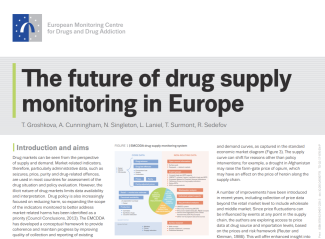
The Future of Drug Supply Monitoring in Europe
Understanding drug markets in Europe requires monitoring both supply and demand. Traditionally, this has relied on data such as drug seizures, prices, purity and offences. However, because drug markets operate illicitly, gathering and...
UNODC (2011a), The Paris Pact Initiative — Evaluating the Achievements: From Partnership to Policy, to Action
The Paris Pact Initiative (PPI), launched in 2003, is one of the leading international coalitions tackling the illicit trafficking of opiates from Afghanistan. Bringing together 58 countries and 23 organisations, including UNODC, it serves...
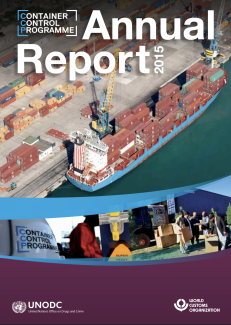
UNODC-WCO (2015), Container Control Programme — Annual Report
In 2015, the UNODC-WCO Container Control Programme (CCP) expanded its reach with new Port Control Units (PCUs) across Asia and Europe, including in Bangladesh, Bosnia and Herzegovina, Georgia, Jordan, Nepal, Thailand and Viet Nam, as well...
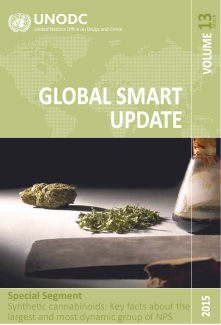
UNODC (2014a), Global SMART Update
The rapid rise of synthetic drugs has become one of the world’s most pressing drug-related challenges. After cannabis, amphetamine-type stimulants (ATS) are the most widely used drugs globally, now surpassing cocaine and heroin. Alongside...
UNODC (2012), In-Depth Evaluation of Paris Pact Phase III, United Nations, New York
The evaluation of Phase III of the Paris Pact Initiative (2010–2012), supported by UNODC’s Project GLO K31, examined how effectively this global partnership has addressed the trafficking and consumption of opiates, particularly those...
International Narcotics Control Board (INCB), Precursors and chemicals frequently used in the illicit manufacture of narcotic drugs and psychotropic substances, United Nations, New York
The International Narcotics Control Board’s 2015 report on precursors highlights global efforts to stop chemicals being diverted into the illicit manufacture of drugs. It points to successes achieved through international cooperation...
Council of the European Union (2013d), The Council of the European Union
The Council of the European Union is the forum where national ministers from all EU countries come together to make decisions that shape Europe. It is responsible for negotiating and adopting EU laws, approving the budget, concluding...
Council of the European Union (2013c), EU‑CELAC Action Plan 2013–2015
The EU-CELAC Action Plan 2013–2015 sets out a framework for strengthened cooperation between the European Union and Latin American and Caribbean countries. Building on priorities agreed at the EU-LAC and EU-CELAC Summits, it focuses on key...
Council of the European Union (2013b), EU-Central Asia Action Plan on Drugs (2014–2020)
The European Union and Central Asian countries have joined forces through the EU–Central Asia Action Plan on Drugs 2014–2020, building on earlier cooperation dating back to 2002. This plan recognises the shared challenges posed by drug...
Council of the European Union (2013a), EU Action Plan on Drugs 2013–2016
In 2012, the Council of the European Union adopted the EU Drugs Strategy for 2013–2020, setting a long-term framework to reduce both drug demand and supply. To put this into practice, the Irish Presidency developed the first EU Drugs Action...